















5 workouts for the outdoors
Now that the days are getting longer, the temperatures higher and the winter dip has been overcome, outdoor exercise is becoming more and more appealing. Have you been making resolutions to get some more exercise for some time, but haven’t gotten around to it in recent months? Turn those spring jitters into healthy habits and try these 5 outdoor workouts! All five of them need cost little to nothing, as you use your own body, what you find outside and possibly some simple tools.
Several of these outdoor workouts are also great if you have little free time. In addition, this immediately gets you a nice dose of fresh air and daylight, which is conducive to your health and energy. Read on and discover these 5 outdoor workouts!
1. Running outdoors remains a great workout
Running is an excellent form of exercise. Not only does it train different muscle groups, your fitness can also improve by leaps and bounds if you run regularly. Running is not only good for your body, but also for your mind. For example, running produces hormones that make you feel good, such as endorphins. It’s nothing short of a “runner’s high”! But running outdoors brings additional health benefits.
For example, participants in a study who went running outside reported that they had more energy, felt less depressed and were more likely to repeat their workout

2. Jumping rope outside
Jumping rope outside is another workout you can easily start. A jump rope doesn’t have to cost much, and you also don’t need much space to jump rope. Jumping rope is excellent for fitness and helps you burn calories and possibly lose weight, according to a study of overweight young people(3). Moreover, you train many different muscle groups when jumping rope, including your legs (calves, thighs and buttocks), arms (biceps and shoulders) and abdominal muscles. Another study suggests that jumping rope is also a good way to promote bone density in your legs
Results from another study show that jumping rope is also beneficial to your overall balance and coordination. Moreover, jumping rope is very intense; you’ll find that it speeds up your heart rate in a short period of time, so you don’t necessarily have to do it for a long time in a row to feel the effect. Thus, you can easily integrate skipping rope into your daily activities. Ideal if you have little free time but still need some exercise. Interrupt your homework session for ten minutes of skipping rope in your backyard and you’re good to go! Of course, you can also jump rope outside as part of a broader HIIT workout. Read on quickly!
3. Do HIIT workout outside
For those who didn’t already know; HIIT stands for High Intensity Interval Training. HIIT includes different types of intense workouts that you alternate with periods of low effort. Jumping rope, sprinting or cycling can all be used for a HIIT workout. A HIIT workout lasts an average of 10 minutes to half an hour. For example, an outdoor HIIT workout can consist of cycling as hard as you can for half a minute, possibly with your bike in gear where the pedaling is heavier. Then you cycle slowly for several minutes, pedaling only very lightly. Then you cycle fast again for another half minute, and so on.
You repeat these steps about five times, depending on how much time you have. The same applies to sprinting or jumping rope; you alternate short bursts of great effort with several minutes of light effort, and repeat this several times. You can also alternate the different forms of exertion, of course. The idea is that your heart rate keeps accelerating and then slowing down a bit. According to some sources, interval training is actually the most ideal for your health(5). This workout is great for you if you don’t get much exercise due to lack of time. In fact, you can experience many health benefits from HIIT workouts in a short period of time.
One study found that a HIIT workout can produce the same results as a longer workout with continuous, less intense effort(6). Participants also reported that they enjoyed the HIIT workout more. Add to that the added benefits of doing a HIIT workout outdoors – the sun’s rays, singing birds and fragrant flowers, for example – and you have a workout that is not only very effective, but also fun!
4. Doing a circuit training workout outside
Circuit training is another time-saving workout that is excellent to do outdoors. In many places there are special outdoor courses for circuit training, but you can also very easily find a good spot on your own. In circuit training, you do a series of different exercises, about eight to 10, training a different major muscle group each time, with only a few minutes of breathing time in between. You can think about push-ups, pull-ups, squats, sit-ups, and so on. Thus, with circuit training, you can undergo a whole-body workout in as little as half an hour.
You can do a circuit workout in different ways, either based on duration or on number of repetitions. For example, you do each exercise for one minute, before resting for two minutes and moving on to the next one, or you do an exercise, for example, 10 times, rest for two minutes, and then move on to the next one. See what works for you! Circuit training is a great way to get a stronger body and better fitness. If you do circuit training outdoors, you get the benefits of being outdoors on top of that, such as better health and mood(7).
5. Bodyweight workouts for outdoors
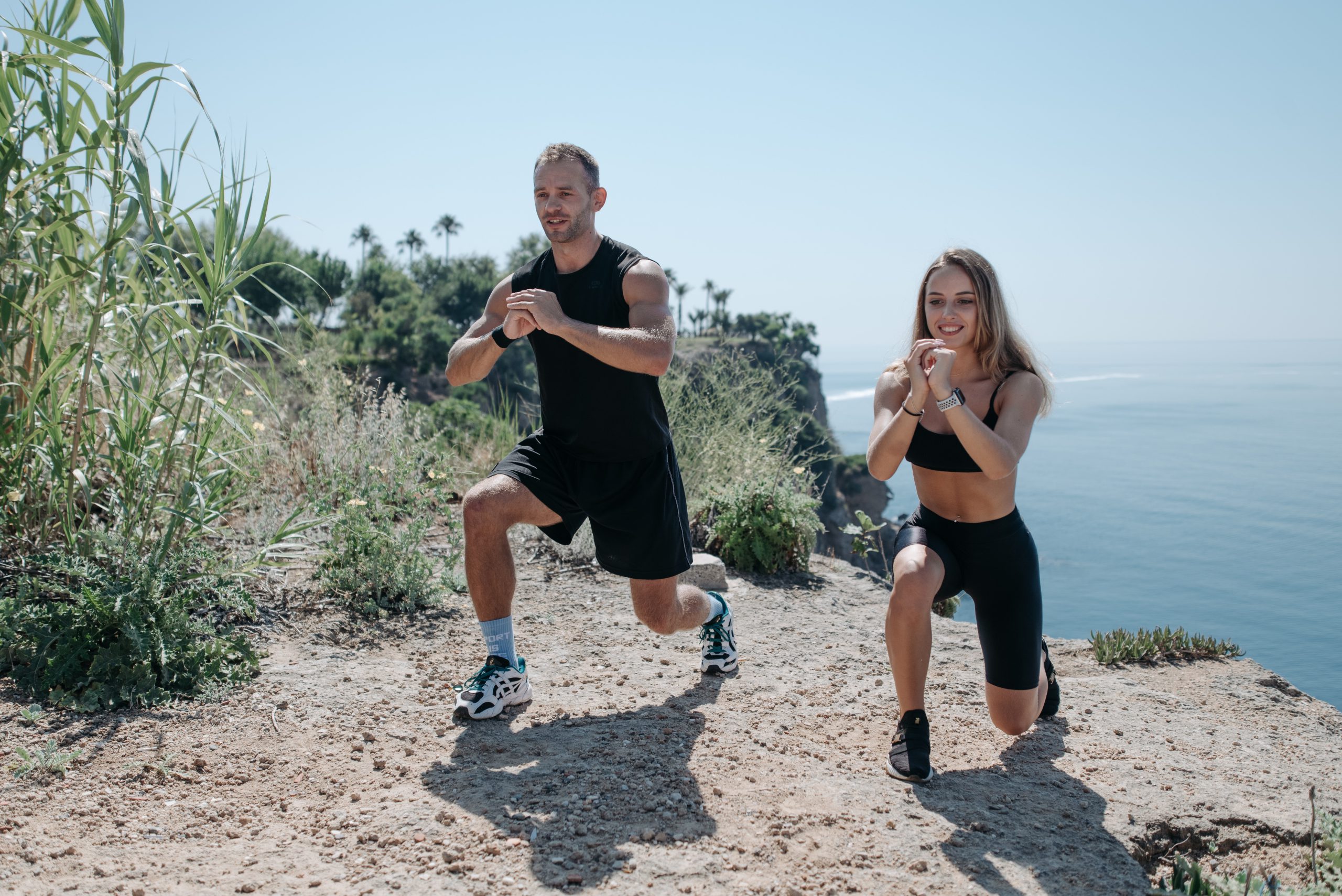
Bodyweight workouts have been around for a long time, but are still popular. Here you basically use only your own body weight, plus possibly some everyday tools, such as a chair or bench. Examples of bodyweight exercises include push-ups, sit-ups and squats. If you’re not in great shape and are dreading a crowded gym full of fit people and complicated machines, a bodyweight workout outside in a quiet spot is sure to be a relief for you. There are several variations to make them a little easier if your muscles aren’t as strong yet.
For example, you can do push-ups standing upright against a wall instead of on the floor, to name just one example. An advantage of bodyweight workouts over exercises with weights is that they usually train several muscle groups at once, in a way that is similar to your daily activities. As a result, the muscle strength you build with them can also be considered more “functional,” as opposed to exercises with weights in which you always load a single muscle group. For example, you’ll notice more quickly that you can carry the groceries, the laundry basket or your baby more easily.
By doing your bodyweight workout outside, you make this form of exercise extra enjoyable for yourself. Want to learn more about the benefits of bodyweight workouts and need inspiration for exercises? Then check out this comprehensive article!
The best outdoor workout is the workout you enjoy doing!
The more you enjoy a workout, the more likely you are to do it more often, according to research(8). If you enjoy a workout enough to repeat it regularly, you’ll reap the health benefits it offers faster and more. Through repetition, your muscles slowly get stronger and stronger and your fitness improves. The exercises then become easier and easier for you, and seeing results naturally works to motivate you as well. Especially if you combine exercise with good nutrition and healthy juices. Is one of the above outdoor workouts starting to bore you? Then try another from the list, for much-needed variety.
This also keeps your workouts fun. It can also be very helpful to meet up with friends, family members or colleagues outside before your workout. This way you combine exercise, being outside and social contact; all important factors for your physical and mental health! Doing your workout outside when the sun is shining will also help your body produce extra vitamin D, which is necessary for good health. Vitamin D supports your immune system, bones and normal muscle function, among other things. Reason enough, then, to do your workout outside this spring!
Resources
Alansare, A. B., Alford, K. L., Lee, S., Church, T., & Jung, H. S. (2018). The Effects of High-Intensity Interval Training vs. Moderate-Intensity Continuous Training on Heart Rate Variability in Physically Inactive Adults. International Journal of Environmental Research and Public Health, 15(7), 1508. https://doi.org/10.3390/ijerph15071508
Coon, J. T., Boddy, K., Stein, K., Whear, R., Barton, J. S., & Depledge, M. H. (2011). Does Participating in Physical Activity in Outdoor Natural Environments Have a Greater Effect on Physical and Mental Wellbeing than Physical Activity Indoors? A Systematic Review. Environmental Science & Technology, 45(5), 1761-1772. https://doi.org/10.1021/es102947t
Jump Rope Training: Balance and Motor Coordination in Preadolescent Soccer Players. (2015, November 24). PubMed. https://pubmed.ncbi.nlm.nih.gov/26664276/
Kong, Z., Fan, X., Sun, S., Song, L., Shi, Q., & Nie, J. (2016). Comparison of High-Intensity Interval Training and Moderate-to-Vigorous Continuous Training for Cardiometabolic Health and Exercise Enjoyment in Obese Young Women: A Randomized Controlled Trial. PLOS ONE, 11(7), e0158589. https://doi.org/10.1371/journal.pone.0158589
Lakicevic, N., Gentile, A., Mehrabi, S., Cassar, S., Parker, K., Roklicer, R., Bianco, A., & Drid, P. (2020). Make Fitness Fun: Could Novelty Be the Key Determinant for Physical Activity Adherence? Frontiers in Psychology, 11. https://doi.org/10.3389/fpsyg.2020.577522
Peserico, C. S., & Machado, F. S. (2014). Comparação entre desempenhos de corrida time trial realizados em pista e esteira. Revista Brasileira De Cineantropometria E Desempenho Humano, 16(4), 456. https://doi.org/10.5007/1980-0037.2014v16n4p456
Seo, K. (2017). The effects of dance music jump rope exercise on pulmonary function and body mass index after music jump rope exercise in overweight adults in 20’s. Journal of Physical Therapy Science. https://doi.org/10.1589/jpts.29.1348
White, M. P., Alcock, I., Grellier, J., Wheeler, B. W., Hartig, T., Warber, S. L., Bone, A., Depledge, M. H., & Fleming, L. E. (2019). Spending at least 120 minutes a week in nature is associated with good health and well-being. Scientific Reports, 9(1). https://doi.org/10.1038/s41598-019-44097-3