















Nightshade, what is it?
Potato, tomato and eggplant, what do they have in common? At first glance, not that much. Yet they are all part of the nightshade family. In this blog, we will discuss which vegetables are nightshades, why they belong to this family and what they are good for.
Background
The nightshade family (Solanaceae) is a family of more than 2,300 different plant species, most members of the family are shrubby plants. A smaller part of the family is herbs or small trees.
Name
The name “nightshade” seems to be possibly derived from the word “damage,” which has its origin in the word “shade.” The family gets its name from one plant, the black nightshade. It is conceivable that the first part of the name refers to the dark color of the berries, reminiscent of the darkness of the night.
Most well-known members of the nightshade family
Potato
Probably potato is the most important and well-known member of the nightshade family. Potato is a plant that grows tubers underground, which are edible, and it grows a small deciduous plant above ground. The potato stores a store of energy in its tubers in the form of starch. It is generally not recommended to eat potato raw because of the harmful substance solanine, which is broken down when you cook it.
Eaten in Holland for centuries, the boiled tuber was brought over from America in the 16th century. At the time of the industrial revolution, a large part of the average worker’s diet consisted of potatoes because they are cheap and nutritious. The potato contains fiber and many koohlydrates, but at the same time very little sugar. The potato contains almost no fats, and is rich in vitamins C, B6 and potassium, among others.
Remarkably, sweet potato is not a relative of the “regular” potato, the sweet potato belongs to the wine family (Convolvulaceae). Sweet potato contains inulin, unlike regular potato which contains starch. Inulin is more suitable for patients with diabetes because it digests more slowly than starch. Also try sweet potato soup.
Tomato
Tomato is also a well-known member. Tomato plants grow as a kind of bush above the ground, from which tomatoes grow like berries. It is impossible to imagine Italian cuisine without the tomato, yet this plant is not native to Europe either. This plant has its roots in South America, where it was grown particularly in the areas around the Andes Mountains.
Among other things, the tomato is known for the presence of the compound: lycopene, which is the natural dye to which the tomato owes its red color. This antioxidant has received much attention in science over the years, there is convincing evidence that it would support in the prevention of chronic diseases
Tobacco
Even tobacco is part of the nightshade family. The tobacco plant, native to the Americas, is a crop that has been grown and used for centuries by Native American peoples for ritual and medicinal purposes. The main ingredient in cigarettes and cigars is controversial due to the harmful effect on the body that smoking tobacco has. Tobacco leaves are used for this purpose because of the presence of nicotine, an addictive and stimulant substance, which is linked to several health problems, including cancer and heart disease.
Other members
Other well-known (edible) members of the family are:
- Eggplant
- Bell pepper
- Cayenne pepper
- Goji berries
Features
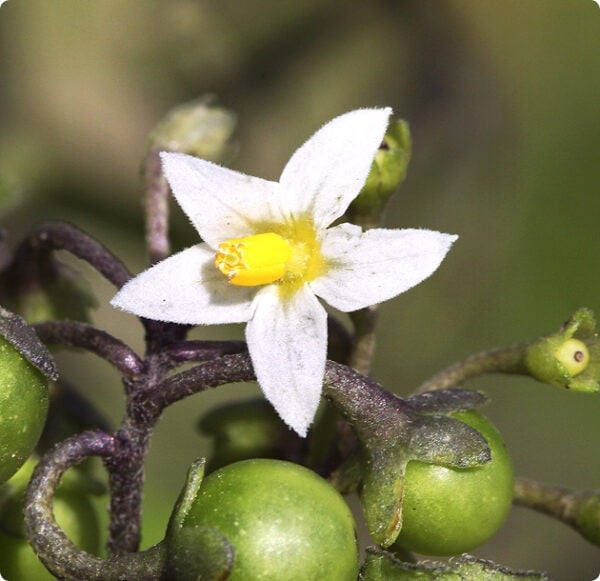
Now that you know some prominent members of the family, you have a certain picture, but how can you identify the next member of the family? There are a number of characteristics by which you can identify a member of the nightshade family. First of all the fruit type, in the nightshade family they are often berries, in the case of tomato very large berries, but also in the case of the potato plant you can see above the ground some kind of berries.
In addition, nightshade can be identified by its flower. Very often nightshade flowers have five petals that are all about the same, looking a bit like a star. The flowers can be white, yellow, purple or blue.
The image below shows both the berries and the typical flower shape of a nightshade.
Phytoftora
Every potato farmer’s nightmare. Phytophthora is a plant disease best known for infecting potatoes; it is also called the “potato disease. Literally translated from Greek, phytophthora means “the plant destroyer. Phytophthora is a genus of fungal öomycetes, symptoms include leaf discoloration, wilting, root rot and eventually a dead plant. Bad news, then. Nightshade-like plants are known to be susceptible to phytophthora.
What is nightshade good for?
First of all, let’s mention that not all vegetables and plants belonging to this family are necessarily good. In fact, many of them are even harmful. All the vegetables that you can safely eat, either raw or after cooking, have their own health benefits. Vitamins and minerals you can find in some members are vitamin C, B6, potassium and so on. All of these vegetables (and spices) can contribute to a healthy diet in which you vary enough and get to your daily serving of fruits and vegetables each day.
What does nightshade do to your body?
What is covered by nightshade?
– Tomatoes
– Potatoes
– Peppers
– Chilies
– Eggplants
These vegetables contain natural substances that can cause symptoms in some people, especially if they are sensitive to them.
Which plants fall under nightshade?
– Bittersweet
– Thorn apple
– Black nightshade
– Tobacco
– Wolfberry (belladonna)
These species contain much higher concentrations of alkaloids and are not suitable for consumption.
Resources
Rao, A. V., Ray, M. R., & Rao, L. G. (2006). Lycopene. Advances in food and nutrition research, 51, 99-164. https://www.sciencedirect.com/science/article/abs/pii/S1043452606510022