












5 tips for outdoor exercise in spring
Has the arrival of spring also motivated you to exercise outdoors? With these 5 tips, you’ll enjoy your outdoor workout even more! Exercising regularly is generally already a gift to your health. Research on the benefits of outdoor exercise suggests that your health benefits from outdoor exercise(1). Exercising outdoors would be especially beneficial for your mental well-being and positively affect your mood, for example(2).
Exercising in a natural environment is also an excellent way to reduce stress. Participants in the study on the benefits of exercising outdoors reported that they were more likely to repeat their workout regularly than if they had to do it indoors(3). And it’s precisely that regularity that you need to take full advantage of the benefits that exercise can bring. It is precisely repetition that improves fitness and stronger muscles. Would you also like to exercise outside this spring? These 5 tips will help you get the most out of your workout outdoors!
1. Don’t dress too warm when exercising outside
Exercising outside becomes a lot more enjoyable when you wear the right clothing. When you just step out the door, the outside air can sometimes still feel fresh. Once you get moving, however, you’ll notice that your body warms up quickly. A little sweating is part of the job, but if you perspire unnecessarily, it can be detrimental to your athletic enjoyment. Clammy clothing does not feel comfortable and limits your freedom of movement. Therefore, do not dress too warmly when exercising outdoors. Unsure about the right outfit and have the opportunity to take something off halfway through your workout? Then opt for thin layers. Are you going for a workout where you don’t sweat a lot, like gentle yoga in the park? Then natural materials like organic cotton are quite suitable. Tencel (or lyocell) and modal are also nice and airy. Do you have cardio on the schedule and are going to exert yourself vigorously? Then there is a greater chance of heavy perspiration and materials that wick moisture away from your skin and/or dry quickly are often more comfortable. Cotton can become very moist and feel heavy and sticky. Tencel does dry a bit faster than cotton. Synthetic materials such as polyester or nylon wick away your perspiration even better and are therefore widely used for sportswear. Would you still prefer a natural material that can wick away moisture well? Then try thin merino wool. This absorbs moisture extremely well and won’t feel wet on your skin when you sweat.
2. Start with a good warm up when you exercise outdoors
A good warm up is always important; whether you exercise indoors or outdoors. If you exercise outside on cooler days, it is extra important to warm up your muscles a bit beforehand. Spend at least 5 to 10 minutes warming up and stretching your muscles. Research has shown that warming up before exercising can significantly reduce the risk of injury(4).
Stretching can also improve your flexibility and make you feel more free to move. Also, warming up promotes your circulation and oxygen transport. Results from another study additionally suggest that your performance also improves when you are properly warmed up before exercise(5). A smaller chance of muscle soreness is another benefit of a good warm up. That may make you more likely to feel like exercising outside again soon!

3. Build up outdoor exercise slowly
Do you want to exercise outdoors this spring, but haven’t done much exercise lately? Build up your outdoor exercise slowly. It’s great if you’re motivated, but if you set the bar too high for yourself, chances are you won’t last long. Give yourself time to build up fitness so that you don’t become completely exhausted and discouraged right away. Building up outdoor exercise slowly is also better for your muscles and joints, helping you avoid injury. Perhaps you have a specific goal in mind with your intention to exercise outdoors, such as participating in a half marathon later in the year. If so, you can very easily create a schedule to build up your workouts. Start from when you want to reach that goal and work back in time step by step to the present. That way you can better see how many miles of running you should start with, and when you can increase the number ever so slightly. Be realistic in your goals and, if necessary, ask for help from an expert if you have doubts about whether your body can handle something. That way you avoid disappointment and keep outdoor exercise fun and healthy!
4. Drink plenty of water
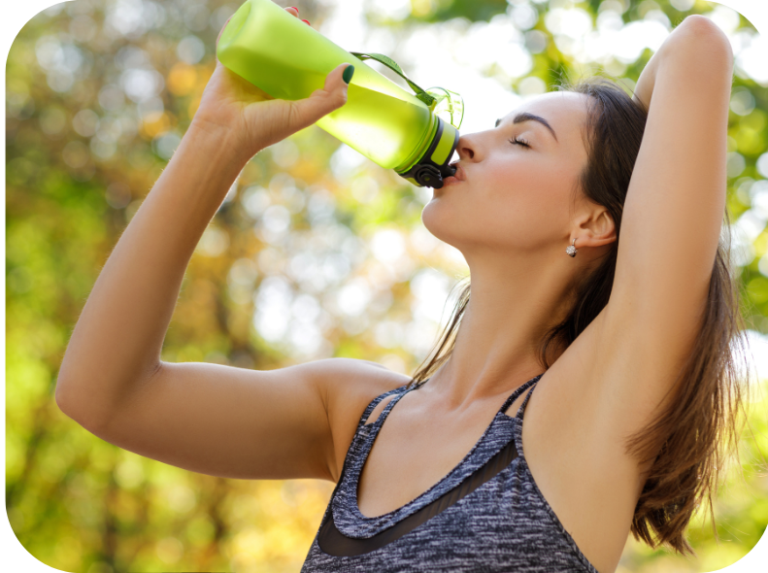
Drinking enough water is always important when you exercise. If you exercise outdoors, especially if it is hot or sunny, staying hydrated is extra important. Drinking enough water before, during and after exercising, for example, can help prevent overheating and sunstroke. When you are well hydrated, you can sweat easily, which helps your body dissipate excess heat. But water does much more for your body than maintain your body temperature. For example, drinking enough water also helps
- keeping your joints supple
- digesting of food
- waste removal
- transport nutrients through your blood
- protecting your brain and vertebrae from shock
Reason enough, then, to always keep a bottle of water handy! Would you like to support your sports performance with the right nutrition? Then read about

5. Keep outdoor exercise fun for yourself
As mentioned, exercising outside can already bring many additional benefits that make it more enjoyable than exercising indoors. You may get a better mood and more energy from exercising outdoors. You may also enjoy it extra because of the beautiful surroundings, the sunlight and the fresh breeze on your skin. Still, you may also get used to this after a while. Then it may be necessary to make sure that exercising outdoors remains fun. Variety is an important factor here. For example, if you go biking, walking or running, choose a different route every now and then so you see something new. Or choose a different workout than usual and go for a circuit workout, for example, or a HIIT workout. The article “Outdoor Workouts” will give you some more inspiration for different workouts you can do outside. The right company can also make outdoor exercise more fun. Maybe there is a friend, family member or fun colleague who would like to join you!
Don’t be too hard on yourself, but at the same time keep challenging yourself enough to make sure outdoor exercise remains fun. A workout buddy can help you with that, too. Sports with a game element, which you can possibly do in larger teams, can also enhance your enjoyment of sports. Consider a game of soccer or basketball outside, or go beach volleyball or frisbee. The more fun you have playing sports outdoors, the more likely you are to continue it!
Sources:
- Gladwell, V., Brown, D. G., Wood, C., Sandercock, G., & Barton, J. (2013). The great outdoors: how a green exercise environment can benefit all. Extreme physiology and medicine, 2(1). https://doi.org/10.1186/2046-7648-2-3
- Bowler, D. E., Buyung-Ali, L. M., Knight, T. M., & Pullin, A. S. (2010). A systematic review of evidence for the added benefits to health of exposure to natural environments. BMC Public Health, 10(1). https://doi.org/10.1186/1471-2458-10-456
- Coon, J. T., Boddy, K., Stein, K., Whear, R., Barton, J. S., & Depledge, M. H. (2011). Does Participating in Physical Activity in Outdoor Natural Environments Have a Greater Effect on Physical and Mental Wellbeing than Physical Activity Indoors? A Systematic Review. Environmental Science & Technology, 45(5), 1761-1772. https://doi.org/10.1021/es102947t
- LaBella, C. R., Huxford, M. R., Grissom, J. E., Kim, K., Peng, J., & Christoffel, K. K. (2011). Effect of Neuromuscular Warm-up on Injuries in Female Soccer and Basketball Athletes in Urban Public High Schools. Archives of pediatrics & adolescent medicine, 165(11), 1033. https://doi.org/10.1001/archpediatrics.2011.168
- Fradkin, A., Zazryn, T. R., & Smoliga, J. M. (2010). Effects of Warm-up on Physical Performance: A Systematic Review With Meta-analysis. Journal of Strength and Conditioning Research, 24(1), 140-148. https://doi.org/10.1519/jsc.0b013e3181c643a0